Showing posts with label bonus. Show all posts

Greeting students

Sometimes the best teaching strategies are the ones that take little effort.  Case in point, greetings students individually as they arrive to class.  Sounds simple enough, no?  You say, "Hello, Jane." and a positive statement or question such as, "It's great to see you today."  Or, you say "Hello, John. How was your track meet?"  Minimal effort, big payoff.


Don't believe me?  Read this study by R. Allday and K. Pakurar.  Greetings students individually increased students' on-task behaviors.  Another study by S. Patterson confirmed similar results (sorry, a free full-text article isn't available for this one on the web; check the e-databases at your school for the full-text article using this abstract).

Bottom line:  Greet students personably as they enter the classroom and see the difference in their on-task behavior.

Just wondering....Do you think this would work at my house?  How about at the gym?

Whole Foods?

Try it the first week of school - and all the other weeks thereafter.....

Jen

Free Business Cards - Reminder

This post originally ran in May.  If you missed it, here it is again.  Call this a thoughtful suggestion.

Many school districts are cutting back on "non-essentials."  I think you having a business card is essential and professional.

Click on a graphic below to create your free, customizable, color business cards. The only thing you pay for is shipping (around $6; US mailing addresses).  What's the catch?  Vistaprint puts a small Vistaprint logo on the back of each card.

Look how sweet this design is.....


How about this one?


Inappropriate for me?  I am more of a truck person.


Just think, if you order now, they'll be in before school begins in the fall.

Yippee,
Jen

Virtual latte, anyone?

Hello there, Upcycled Education stranger.  Lovely to see you again here in the blogsphere.  My last month away gave me time to....

Enjoy little O and friends....

(little O and CM at the Cystic Fibrosis Walk and Fundraiser)

Create charms and necklaces with my new metal alphabet stamps....

(Nifty, no?  Maybe we need Upcycled Education ones)

And enjoy the outdoors.......


(Our family loves biking festivals and camping opportunities; Funny O expression, no?)
Now, that I am back from my blog haitus, it is time to crank it up again.  Albeit summer and I do plan to travel, play and relax a ton; Little O and P are my sidekicks.  However, Upcycled Education will continue and I have big plans for the coming year.

(Insert:  Yahoo!  Yippee!  Wahoo!)

In the meantime, to keep up with all the latest posts, do "like" Upcycled Education's Facebook page or subscribe to the RSS feed or become an email subscriber (my personal favorite).  All of those features are off to the right side of the blog to help you.  See them over there?

OK, I am off to purchase our virtual lattes.  Do you want yours full caf, half-caf or decaf?  Skinny or whole milk?  Soy or cow's milk?

Yep, I aim to please here at Upcycled Education.

Your friendly barista-blogger,
Jen

Best of Show: Upcycled Education

Most of the blogs I read do a "best of" series at some point.  I thought I'd try my hand at one.  What's lovely about blogging on Blogger is Google keeps track of all sorts of statistics for me.  For example, I can see which posts are the most viewed, which search terms readers use to find Upcycled Education and from which countries viewers hail.


Did you know our sweet, lil blog Upcycled Education has viewers from over 20 different countries?  With the United States, Canada, India and UK readers heading the pack, the blog has also attracted readers from Germany, Taiwan, Australia, South Africa, Greece, Romania, Thailand, Vietnam, Singapore, South Korea, Sri Lanka, Indonesia and Denmark - to name a few.  Upcycled Education goes internationale - in spelling, too, apparently.


Ready to countdown the top five, most viewed blog posts on Upcycled Education?

I am seriously still addicted to this freebie font website.  Three case-in-points, the photos in this post.  See the cool fonts I used in all of them?  The tippy-top font used on the train track photo is "St. Andrew."  The middle script font used with little O modeling is "ChopinScript."  The last font used with the flowers is "Woodcut."  I literally keep a list of the fonts I download taped to the wall in my studio, so I remember the unique names of my favs.

On my to-do list next week is to make a couple of presents for friends using this post.  This summer, you could make your own artwork and have them ready to hang-up in your classroom just in time for back-to-school in the fall.

I am not surprised this post made it into the best of show.  Dr. Mitra is brilliant and his work can be applied to just about any educational setting.  If you didn't get a chance to watch the TED talk included in this post, treat yourself.  By the way, I have the TED phone app and it is the perfect way to watch TED talks on the go.  Actually, I headphone up sometimes while I am washing the dishes at home and listen/semi-watch a TED talk.  Not only am I tidying up the kitchen, but I also enter a state of flow.  Remember this post?

There may be two reasons this post ranked so high on Upcycled Education.  One, it was our first giveaway.  Two, because it rocks.  Check out Presenter Media when you want to snazzify your PowerPoint presentations.  Remember, they offer an educator's discount, since this is a pay, subscription service.


And the #1 top post, best of show on Upcycled Education.....

#1 - Montessori Education, Part II
I could cry.  You know how I love - wait, that needs more emphasis - L-O-V-E Montessori education.  If you haven't read this post or Part I of it, you must.  Ms. J and Ms. Z did a fantabulous, amazing job explaining Montessori education.  I have literally never received so many emails and thank yous about the post.  This shows the power of this "best in show" post - to demystify Dr. Montessori's classic and pure methodologies.

I'm off to celebrate the top five with an early morning road bike ride....

My best,

Jen


Drop caps how-to

D

id you see my pre-Mother's Day post on May 7th?  If not, scroll down to it.  Isn't the first letter fancy?  Hey, just like the "D" to the left is fancy in "Did?"

Aren't you wondering how I jazzed up my "D?"

Simply stuff, fabulous blog reader.  Just visit Daily Drop Cap, choose your letter and follow the instructions below each letter.  It does require copying and pasting HTML code, but its 2011, I am confident you can do that, yes?


This drop cap stuff is thoroughly entertaining to me. 

Grinning from ear-to-ear,
J


en


PS - Do you think I could use the drop cap letters to make more DIY artwork for my classroom?  Remember this post here?  My wheels are spinning.

Mother's Day Printable

Y

ep, you can thank me later.  Actually, you can thank me and Amy Moss, the designer, later.  We just saved you from having to run to the store and purchase a Mother's Day card. 


Click on the image below to link to this free and sweet - like your mama - Mother's Day card.  It looks fantastic printed on white or ivory cardstock. 

Your mom is going to adore you.  Just like I do, fabulous blog reader.


Happy Mother's Day to all you (and your) amazing moms!

Jen

PS - If you like my fancy "Y" at the beginning of the post, check back next week and I will reveal my source and "how to."  Neat-o mosquito, huh?

The "Other" Jen

As you remember from my blog post here, there are over 1.4 million Jennifers in the world.  I'd like to think we are all created amazingly equal.

And so I will.


A decade ago while attending my first International Association for Experiential Education (AEE) Conference, I met another Jennifer - Jennifer Stanchfield.  She like me shared similar interests:  a passion for working with kids and adults, knowing learning experientially is powerful & rich and recognizing the AEE community is comprised of kindred spirits like us.  I've attended at least seven AEE conferences since meeting Jen.  We always embrace when we see each other.

Kindred Jens, we are.

The "Other" Jen has authored and co-authored books.  She leads numerous workshops and trainings around the country on topics such as creating classroom communities and differentiating instruction.  She has the neatest store with the perfect educational props.  Look at this unique Miniature Metaphors set.  Isn't it divine?  You know how I love metaphors.  Seriously, can this collection of miniatures be more engaging?


Did I mention Jen blogs?  Check out this blog post on starting off your lesson with style.  Then, you must read her inspiring post on using quotes in your classroom.  Click here to do so.


If you are like me and can't get enough of her creative ideas, then go visit Jen's blog or her website, Experiential Tools. 

Jen S. is making me proud to be a Jen, too.

Thanks, Jen. 

Best,

The "Other" Jen

Mod Podge for Education

A perfect world:  Combining crafts and education into one.  Craftucation, I might call that.  Me?  I craftucator.

Happiness.

To bridge my two  three loves, I combined Mod Podge, some basic craft supplies and my trusty assistant, little O.  Our task:  To make something that is crafty and educational.

Hmmm...what to create?  How about a reflective tool?

At our local craft store, Jo-Ann, we located these fabulously, inexpensive wood blanks.  Jo-Ann had so many shapes and sizes.  I think we paid $.29 for each wood blank.


Next, little O and I painted them with acrylic paints we had around the house. 


Using leftover scraps of patterned paper, little O traced each shaped and I cut out the shapes.  We broke out a must-have, craft companion...Mod Podge!  Here you can see little O gluing on the patterned paper to the painted wood blanks.  Mod Podge is a craftucator's best friend.


After letting the Mod Podge dry (about 20 minutes), this is what they looked like.  Kind of fresh & engaging, no?


To help transform these gems into a reflective tool to be used in the classroom, little O traced more shapes for me.  This time, she used plain, colored paper.


I then cut out the traced shapes and wrote reflective prompts on them in black Sharpie marker.  The reflective prompts included:
  • Describe the main idea from today's lesson.
  • Describe something new you learned today.
  • Explain two new terms from today's lesson.
  • How can you apply today's lesson?
  • What other topics relate to today's lesson?
  • Why is today's lesson important to you?
  • How would you improve today's lesson?

Don't you love reflective questions?

The finished product, the reflective prompt side, looks like this......


To protect these Mod Podge, craftucation treasures, little O and I brushed on two layers of Mod Podge on each side.  We let the Mod Podge dry about 20 minutes between layers.  They are sealed and student-proof now!

Not that my college students are destructive, however, now they can happily risk a vanilla-soy-latte being spilled on them.

Oh, craftucation and happiness!
Jen

PS - I just used this reflective tool with my college students after teaching a lesson about identifiying gifted and talented students in preK-12 settings.  When I polled my college students about the tool they described the colorful prompts as "cool, fun, unique and playful."  More happiness.

PSS - Happy Teacher Appreciation Week!  I personally don't need a week because I appreciate you all the time.  True.

Dear Crayola

To Whom This May Concern,

Please send me a case of the following items.  I am a teacher and need them for my classroom.

Window crayons and markers so we can thematically decorate our boring windows.....


Fabric markers as my students and I want to make lesson t-shirts.  They sure would be fun to wear on test days.


I could really use some help spicing up my dry-erase boards.  I think these bold color dry-erase markers would do just the trick.


Multicultural markers so we can....accurately represent diverse skin tones from around the world?  Really?  OK, I will try anything once.


My college students think I am the coolest professor when I take them outside for class on a sunny day .  This sidewalk chalk would be great for lesson review and reflection; Students could visually draw their understanding and the whole campus could walk by and stare and be envious.


Would you say Model Magic smells as good as Playdoh?  My kinesthetic learners would be elated to sculpt their learning. 


I don't mean to be presumptuous, but if there is any room left in the boxes you send, can you throw in a Glow Station for little O?  This looks like a great item for a long car ride.


By the way, little O and I are big Crayola fans.  See your Window Crayons at work?


Thank you, Crayola.

Sincerely,

Jen

The Wheel

Happy Wednesday!  Are you on Spring Break still?  Right now, those of you not on Spring Break - like me - are envious.

No, make that jealous.

Yep, I feel jealous.  I deserve another Spring Break.  (Yes, I already had one).

To keep my posts less-text and more visual this week, I have a download for you.  Why not get your students reflecting on what they've learned in class?  Remember these deluxe reflective tools I shared with you?  How about these paper Twitter debriefs? 

You would make John Dewey and Jean Piaget proud if you nestled reflection in your lessons.  Apparently, Confucius, too:  "Study without reflection is a waste of time, reflection without study is dangerous."


Click on the above image and download this favorite reflective tool ready-to-go.  When you get back from Spring Break, all you will have to do is make copies.

Sorry trees,

Jen

Race to Nowhere: From a student's point-of-view

Way back in February, I mentioned a documentary on education, The Race to Nowhere.  If you missed that super-short post, click here.  I finally, almost two months later, saw the film.  I was so thought full (yes, I just typed that as two separate words on purpose) after seeing the film that my friend and I literally sat in my car in her driveway to almost 11pm discussing it.


Apparently, we weren't the only two moved.  One of my amazing college students, Jasmine, had something to say about the film.  Today's post is brought to you by Jasmine - a sophomore majoring in teacher education.


Take it away, Jasmine.


There are many concerns amongst teachers, parents, and students about the impact of current school programs and high-stake tests on students' well-being. The government and some educators do not realize the stress many children experience during the school year. The impact this stress has on the students not only affects the students cognitively, but also physically and emotionally. After viewing the documentary, Race to Nowhere by Vicki Abeles, I am now aware of the stress that not only students go through, but their parents and their teachers, as well. I have also developed an opposing viewpoint against the way the government influences school programs across the nation.

As I watched Race to Nowhere, I immediately thought of my father. When the students would talk about the heavy emphasis their parents put on them about school, I knew exactly how they felt because my father was the same exact way as the parents mentioned. Throughout the documentary, I began to feel like I was in grade school; remembering all the stress I went through to get where I am today. I began watching the documentary as an educator and teacher and finished watching the documentary as a heartfelt student whose voice needs to be heard.

Personally, I believe the documentary is necessary and should to be shown in every school district. From my point of view, our voice - the voice of a student - is not being heard and that needs to change immediately. There are many peers of mine that stress themselves out to do well on a subject to please the teachers, but not themselves. For instance, a close family member of mine is a devoted mother, who works two jobs, takes 17 credits at a community college and is a member of the college’s honor society. She often experiences anxiety attacks even when the professors mention to her that she is doing very well. Though she receives positive feedback, she somehow feels that she is not doing enough because of the stringent requirements of the four-year college she will be transferring to next. This message, in my opinion, is what the documentary strives to convey. Students are overstressed.  Students need to have minimum school related stress so they can balance multiple priorities in their lives such as their health, participation in activities like sports, work and family. As discussed in one of my education classes, students need recess time in school so they are able to recuperate from sitting in their seats all day long doing seat work. When a student is overloaded with piles of school work and high stakes tests, often times recess is eliminated or lessened.  Without recess or down time, students are unable to reflect on what they have learned and they begin to develop serious physical and/or emotional problems, such as sleep deprivation. Overall, Race to Nowhere is evidence this message needs to be heard amongst everyone involved in education to not only better the students' well-being, but the future of this nation and world.

As a student, I have been impacted by this documentary emotionally. Throughout the documentary, I had an urge to scream out these students are right; what the educators are saying is true; and the government needs to change its demanding mandates that cause undue stress on students and teachers. To do so, one idea involves rethinking homework.  According to current studies, reducing the homework load in half has a positive impact on academic achievement. Perhaps, schools could consider this research and change their homework policies and workload to lesson student stress.  On http://www.racetonowhere.com/, there are many resources for myself, both as a student and a future educator. I am more aware of ways to make my educational experience more meaningful and how to adequately manage time spent on school-related activities.


As a future educator, I now am more cognizant of a student's cry for help. I am currently thinking of ways to increase student achievement in my future classroom while reducing my students' out-of-class workload. I am also considering how to incorporate more kinesthetic, hands-on learning.  If students are undergoing stress in school (and possibly at home), I will be proactive and be sure my students are engaged, but not overtaxed.  Overall, the documentary has made me think more about the techniques and lesson plans I will employ to manage my future classroom, as well as, be an effective teacher.
Though the documentary was educational and inspirational, there is still an underlying problem of who places mandates on our schools. Though teachers can slightly alter the students' workload, they often cannot change the local, state, or national mandates. A driving force is the fact that the government, with its laws and mandates, has tremendous power over our school systems. Though the documentary sparks attention, the issue that needs to be addressed is how educators can meet the needs of their curriculum while honoring the mandates and still make school meaningful to the children. In doing so, this will end the race to nowhere.

Race to Nowhere by Vicki Abeles is a valuable resource for myself and many other people interested in improving education. It is time for change in our schools; voices need to be heard. With the momentum of this documentary, many voices can be heard through the petition to “end the race.” Awareness about the nature of our schools is imperative and I am proud to be an advocate. 


Do you see why I love my job?  I teach current teachers and bright, future teachers like Jasmine.


Go see Race to Nowhere.  You can click here for screenings.  If you haven't seen Waiting for Superman, another documentary on education, perhaps you can treat yourself to a double-feature.


Thank you, Jasmine, for sharing your point-of-view.  Your students are going to be one lucky group to have you as their teacher one day.


Best,


Jen

HALTED

Update: Here's another post to support this...the Feelings Wheel.

This one is seriously one of my favorite strategies to teach students of all ages (and adults).  It is a way to describe your emotional state when you are feeling less-than-perfect.  Since I am an adult, I use HALTED to dissect how I am feeling.  My husband will attest to the fact that I am not myself when I am feeling "H" - hungry.  I know I am not myself when I am feeling "T" - tired.  Since little O is young, I think of HALTED when she is acting out-of-sorts or experiencing a melt-down.  I run through the acronym in my mind to figure out what is driving her behavior and in doing so, I am able to better help her.

Ready to HALT yourself?


Are you feeling....

H - Hungry?
A - Angry?
L - Lonely?
T - Tired?
E - Embarrassed?
D - Disappointed?

Some days I think, HALTED-OS might also be helpful:

O - Overwhelmed?
S - Scared?

I would love to give credit to the student who taught me HALT a decade ago.  Since that time, my college students and I have added the ED and OS parts.

Do you have other tools that help humans express their emotions or at least recognize their emotional state?  Daniel Goleman has said the first part of emotional intelligence is self-awareness. 

With HALTED, we are on our way.

Jen

PS - I think little O might be ready to be formally taught the acronym.  The other morning she woke up incredibly cranky.  For at least five minutes she was giving me a hard time about nothing.  Then, I ran through the acronym in my mind and said, "Are you hungry?"  I didn't even need to get to the other letters because she agreed, she was hungry.  I ran to the kitchen, grabbed a string cheese, she devoured it and was a new person in minutes.  The rest of our morning was enjoyable.

PSS - Here's the link to the Feelings Wheel.

(Deluxe) Reflection Tools

Most teachers and educational theorists agree - "real" learning involves reflection.  Thus, save a bit of time after a lesson to provide ample time for students to reflect - five or more minutes is ideal - depending on the complexity and familiarity with the topic.

(From Leo Reynolds Flickr Stream; Photoshopped by Jen)
Here are some easy-peasy reflection tools; I've gathered these over the years from other educators, conferences, and workshops, thus no citations are included:


Symbols – Using playdoh, pipe cleaners, and/or art materials, have students create a symbol representing what they learned that day.  My favorites are the giant piper cleaners – look for them at craft stores near you.


Weather, Geography or Landscape Report – Ask students to connect what they learned in class that day to a weather pattern, geographic location or type of landscape.  For example, a student might say, “The story of Romeo and Juliet to me is like a partly sunny day with severe thunderstorms in the afternoon.  The sunny part of the day is when Romeo and Juliet meet.  The thunderstorm happened when Juliet died.”

Switch-off - Create a thoughtful, open-ended, higher-order thinking question for students (you should be thinking of Bloom's Taxonomy right now, yes?).  Allow students time to reflect and write their answer.  Then, have students switch papers with a classmate and react to what their classmate wrote.  Do these switch offs as many times as you see fit.

Headlines – have students generate a newspaper headline to represent what they learned in class that day.  Also, use this activity to assess students’ energy levels, emotional states, connections to material, etc. 

Thermometer of Learning – This one takes the least amount of time.  Post temperatures on the wall by the door.  Ask students to touch the temperature that represents how much they learned that day. 
Photographs – Ask students to reflect on the lesson that day.  What stands out in their minds?  Now, ask students to take a photograph (in their mind) of that part of the lesson.  What does it look like?  Who was doing what?  What was their role in the photo?  This might be a fun one to recreate with cell phone cameras.  Oh, does your school still ban cell phones used educationally?


If you missed the tweet exit ticket from last week, click here.  It, too, encourages reflection.


Best,
Jen

Twitter Exit Ticket

Are you on Twitter?  Are your students' parents and families?  Did you answer yes?  Very techy.  No?  Are you living under a rock?

...OK, that was mean.  But, this is the 21st century.


According to Twitter's blog, 140 million tweets are sent a day which adds up to a billion tweets every eight days.  Yes, I just quoted a billion.  What's everyone talking about?  Life, love, the pursuit of happiness, favorite coffee drinks from Starbucks, what's on the dollar menu, how much snow dumped on Colorado's ski resorts, education, why Trader Joe's is so cool, Pink's new song...wait, did I just say "education?"

Rewind.  Yes, people are tweeting about education.  One of my favorite educational tweets is from Edutopia (George Lucas created this foundation, so you know it is cool).  You can visit (or follow) their tweet here.

Why not tweet in your classroom?  Oh, I know what you are going to say, you don't have enough computers, iTouches or smart phones.  No problem, I made you a tweet exit ticket.  See?  You can go old-school with this download and print it on paper. 

Voila, a paper tweet.  To get yourself a full page of these tweet-a-licious reflection tools, click on the image below.


...I'm kind of sassy today, aren't I?

Tweetles,
Jen

PS - In case you liked yesterday's post on cloud computing and Common Craft, you might also like this video made by Lee and Sachi explaining Twitter.  I am helpful and sassy, yes?

Helping students from poverty

This is Part II of our discussion on poverty from last week.  If you didn't read that initial post, click here.  Today, we will arm ourselves with creativity and ideas from academia to help students from poverty succeed in our classrooms and beyond.

(From Leo Reynold's Flickr stream; Photo taken in Scotland)
Ideas to consider:

Roots and Wings - Help students feel deeply rooted in their communities (families and schools), yet have strong wings to attempt new adventures and opportunities.  The best way to grow strong roots is to embrace the "it takes a village..." philosophy.  When mom, dad, grandma, cousins, aunts, uncles and caregivers are involved in a student's schooling and school, roots naturally become strong.  To help students grow wings, look at enrichment opportunities in your area or in an interest.  For example, if you know a student has an interest in outer space, could you find a mentor in your area (or via email) to buddy-up with your student and share their space expertise with them?  Or could you help a student write an essay to secure a scholarship to "space camp" for the summer?  Roots and wings...foster them both.

Developmental Assets - Remember this post on the Search Institutes's developmental assets?  This is a great way to help students from poverty as it is not about finances, but about other supports to help students.  Remember the more assets a student has, the more likely the student will not engage in risky behaviors.  Consider going back to this original post and printing off the developmental asset sheet for your students' age range as a reminder of which assets should be fostered.

Maslow's Hierarchy of Needs - Since poverty affects the foundation of Maslow's hierarchy of needs, brainstorm ways to help students get their "deficiency" needs met.  For example, if a student is homeless, can you have the address handy for a local homeless shelter and slip it privately to them?  If the student does not have a safe or quiet place to complete homework, could you open up your classroom 2-3 afternoons or early mornings a week for students to use the space as a study hall? 


Read Dr. Ruby Payne's book, A Framework for Understanding Poverty - This book should be mandatory for any educator who works with students from poverty.  A favorite section of mine is Dr. Payne's discussion of "resources" for students.  Of course, the obvious resource for a student from poverty would be money or strong finances, but let's face it, as a teacher, that resource is often times lacking even for us.  Dr. Payne states that being impoverished is not solely about money.  In fact,  in her book she lists seven other resources that can be just as valuable to students.  The top resources for students, in addition to having financial resources, would include:
  1. Emotional - Having emotional intelligence and the ability to be resilient when failures or setbacks occur.  I feel a blog post on this topic coming on.....
  2. Mental - Basic academic skills like reading, writing and mathematics; necessary for promotion in school and business.
  3. Spiritual - Believing in a purpose greater than oneself.  (Very Daniel Pink, this one, isn't it?)
  4. Physical - Having adequate physical health and wellness.
  5. Support Systems - Knowing that a strong network of family and friends exist and can be supportive.
  6. Relationships/Role Models - Having access to nurturing adults who model appropriate behaviors.
  7. Knowledge of Hidden Rules - Knowing the unspoken rules of a group.  An example may include writing a thank you note after a person does something nice for you (a very middle-class rule).  My grandmother would be saddened to know I still have not written thank you cards for gifts received over the holidays - four months ago!  As a teacher, you need to explicitly teach the hidden rules to your students from poverty if they do not know them.
  8. Financial - Having enough money to purchase goods and services.
According to Dr. Payne, three or fewer resources for a student is problematic.

Mirrors and Windows - Surround students with good people and growth experiences that allow them to see themselves in a clear light (and see others who are just like them), while providing windows to see beyond their immediate situation or neighborhood.  When I taught on the Navajo Nation, I comfortably provided many windows for students to see beyond their lives on the reservation, but since I am not Navajo (read: not a great mirror), I sought alternative ways to provide mirrors.  For example, how can students see themselves in a book character or a time period in history?  Which chemical element is most like them?  If you need help with mirrors, try what I did and connect mirrors to your subject area or content.

I believe this would be a fantastic post to hear from you in the comments section.  What other ideas do you have to help students from poverty?

Best,
Jen

Typos: My nemesis

Please forgive me, English and Language Arts teachers of the world.  And yes, I realize I am one.  I know this blog is riddled with typos and grammatical challenges.  I need an editor, indeed.  Any volunteers?

And just to make myself feel better, at least I didn't plaster my mistakes on a roadway.  See?  Things could be worse. 


For the full story, click here.

Ugh,
Jen

Teaching Abroad

Many of you know my background from reading my initial post here.  If not, I have taught in a hodgepodge of amazing places both in the US and abroad.  Here are some leads and tips for landing a job abroad.

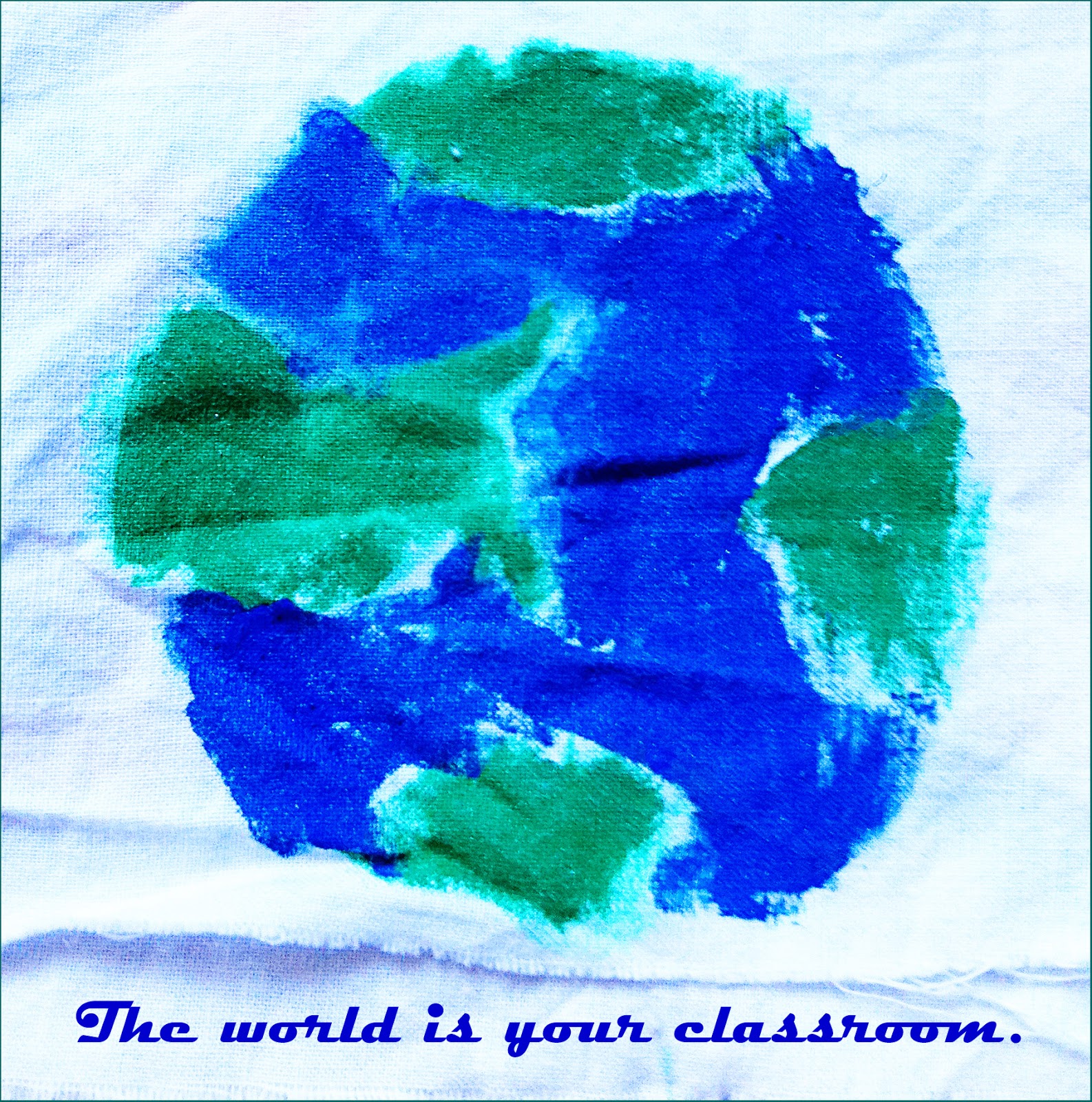
(Drawn on fabric by Jen; Hand painted by little O)
International Teaching Fairs
  • Attend an international teaching fair.  Two of the biggest are the UNI Overseas Recruiting Fair and the ISS Fairs.  Both organizations offer fairs in February, thus, I'm planting a seed for next year, 2012!  I attended the UNI fair a decade ago just to see what the fair would be like and literally landed six jobs all in South America, my targeted destination.  Both fairs require you are a certified teacher.  The fairs also require an application fee.  What I appreciated about the fairs is they mean business!  The international schools in attendance are ready to hire - impressive schools from all parts of the globe - Switzerland to China to Ecuador and beyond.
  • Before the fair, prepare!  Research schools, countries, curriculum, special programs, etc.  Many schools abroad have IB programs, so familiarize yourself with those if you are not already savvy. 
  • In your research and at the fair, target an area of the world you'd like to teach or be open to many areas of the world.  For me, I only wanted to live in South America (a life-long dream of mine at the time) and thus, I focused on job positions there.  I didn't even apply to positions in other countries while attending the fair nor entertain requests to interview with other countries.  And yes, many schools will seek you out to interview as they all have access to your resume and credentials.  I must say, it felt really great to be wooed by schools.
  • At the fair, be ready for long days!  You will need to dress professionally, have extra resumes on hand, possibly bring your teaching portfolio (more on this in a moment) and arrive to the fair ready to shine!  You need to be your most engaging self while at the fair.  Get a great night's rest.
  • Most job fairs are multiple days.  I did land all six jobs in one day and thus, the second day of the fair was spent determining which job offer to accept - which is awfully exciting.  However, many of my comrades were interviewing and scouting out schools on the second day, so be open to a busy fair schedule.
  • I only advise bringing a current teaching portfolio if you plan to use it.  I like to use my portfolio (which could stand a major revision and update) when a prospective employer asks me a question that I know my portfolio (and I) can address.  I then will flip to the part of my portfolio that demonstrates my response to their question and the employer can visually see my response while I describe it.  For example, if an employer were to ask me about assessment, I could flip to my assessment section and show some of my original assessment tools and assignments.  Seeing is believing sometimes and that's when portfolios are most helpful.  If you have an electronic portfolio, use it if you can easily access the artifacts.  You certainly don't want employers to wait for you to locate and open your documents or photos.
  • After your interviews at the fair, bring thank you cards to hand write to the schools who interviewed you and leave them immediately for your prospective employers.  I made my own cards that said, "The world is my classroom," on the front.  Thank you cards help put your name in front of the prospective schools one more time.
  • If you are married or in a relationship with another educator, you can also apply and interview as a team.  Most of the fairs have a system for doing so which makes interviewing and landing positions together doable.  If you are married to a non-educator and/or have children, most international schools have systems to hire you and have your family accompany you with ease.  US kids growing up in international schools have a unique opportunity to see the world, learn new languages, and travel.  Win-win-win.
(I always thought it would be enjoyable to teach in Costa Rica, too...)

DOD Schools - Department of Defense
  • This is not my expertise at all, DOD schools, but I do know of educators who have enjoyed working at DOD schools. 
  • According to the DOD website, you can target an area of the world that interests you and explore current job postings.
  • Most DOD schools are located on military bases and attended by US students only.  International schools, alternatively, are mainly attended by locals from that country - which is my preferred clientele while teaching overseas.
Teaching in the US, but immersing yourself in another culture
  • If you are not quite ready to make the jump to another country, consider staying in the US, but teaching in another culture.
  • If you are from a rural area, consider teaching in an urban setting.  If you are from a Hispanic community, consider teaching in a predominately Asian one.  In the US, there are many opportunities to immerse yourself in new cultures and environments.
  • My personal favorite spot to teach in the US is in Kayenta, Arizona on the Navajo Nation.  Gosh, I adore my Navajo high school students and their families.  Thankfully, many of my students from a decade ago still keep in contact with me.  This school district, Kayenta Unified School District, was superb and each year, they look for dynamic teachers.  You can see their current job postings here. 
If you have any questions on landing a job overseas or even teaching on the Navajo Nation, please email me at jenglara at gmail.com or leave a comment below.

Happy teaching, exploring and traveling,
Jen

Preparing for St. Patty's Day

I thought I would never be one of those teachers (or moms) who lived from one holiday to another, alas, I have semi-become that educator.  I still don't wear decorative sweaters for each holiday, but I am unafraid of celebratory artwork. 

Option #1:  "Lucky" artwork from the Funky Polkadot Giraffe blog

I love the upcycled buttons in this one.  Wouldn't this one be cute framed or as a gift?  In the meantime, you could do a quick color print on your home printer and hang the artwork on your classroom door.  Your students are "lucky" to have you, aren't they?  To access, click on the image below and download the file.  You can choose from three different sizes to print thanks to Kyla from the Funky Polkadot Giraffe.  I added the green frame around the edge myself for more St. Patrick's day flair.


Option #2:  "Rainbow quote" from the Simple as That blog.

As you can see, I am embracing St. Patrick's day, but not focusing on the "saint" part.  I am all about a good rainbow.  To access, click on the image below and download the file.  From Rebecca, you have just one option on size (though, you could resize it in Publisher or another program).   I added the green frame around the edge myself, again. 


If you have other St. Patty's day artwork leads, please post them in the comments section below. 

Cheers,

Jen

Motivational spa treatments

In preparation for tomorrow's post on Daniel Pink's book, Drive, it is time to incite your motivation.

Give yourself the luxury of five minutes.  I know, I know....who's got five minutes to spare?  Consider today's post a spa treatment for your soul.

Photo by Leo Reynolds; Photoshopped by Jen
Spa treatment #1 for motivation
Set the timer on your cell phone for three minutes.  When time begins, answer the question:  What motivates me?  Keep writing nonstop until time is up.  If you run out of things to say, keep repeating the question aloud "What motivates me?" and answer it.  Do not concern yourself with spelling, punctuation or being repetitive. After, take a look at what you wrote.  Underline common themes or big ideas.  Your stream of consciousness has something to say.  What did it reveal about what motivates you?

Spa treatment #2 for motivation

Use Pink's "big question" activity.  "In 1962, Clare Booth Luce, one of the first women to serve in the US Congress, offered some advice to President John F. Kennedy.  'A great man,' she told him, 'is one sentence.'"  What is your one sentence? 

Me?  Jen lived her life passionately embracing the motto - life is an adventure.  First draft.

Spa treatment #3 for motivation

Create an inspiration board.  Pink advocates doing this as do most artists and designers.  You can put one together fairly quickly especially if you have your favorite magazines, catalogs, and photos laying around.  Here is my board right now.  It inspires me (although the photo quality doesn't).


Spa treatment #4 for motivation

DIY motivational signage.  This one, which I found in a Patagonia catalog last winter, cracks me up.  For skiers/boarders, it is plain and simple motivation to choose a trail wisely.  Seeing it, brings me delight - which in itself is motivating.


To create your own signage, check out this free web-collection of tools, Big Huge Labs.  I lost count at 20 how many options they have to create your own signage.  The "Motivator" tool might be just what you are looking for...(though, I could see your face on the cover of a faux magazine using the "Magazine Cover" tool).


Alrighty, go give yourself a motivational spa treatment.

Come on, you deserve it :)

Jen